Reviewed by Dr Sara Day
Free HIV Test Kit by Post
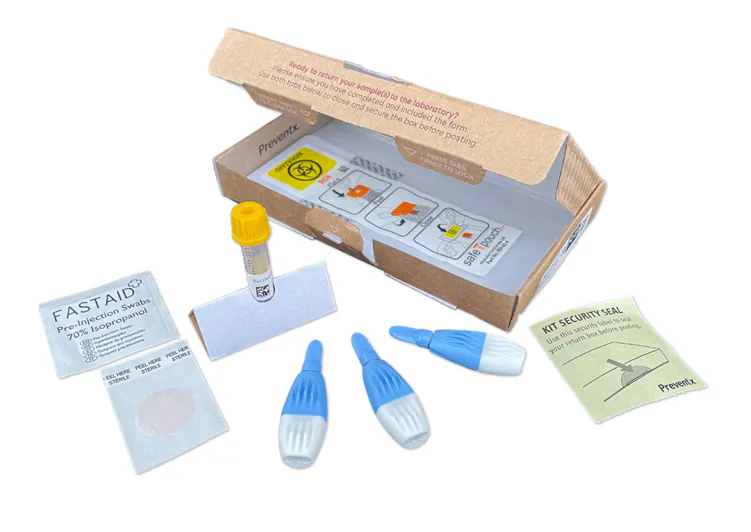
Description: Get a free, fast and reliable HIV home self-sampling test from SHL. Take your own blood sample at home, post it to our lab to be tested, and get your confidential results online.
You prick your finger with a special needle called a lancet. Then collect some drops of blood in the sample tube. We have lots of tips to help you collect your blood sample. It’s a very small amount of blood and most people can manage it.
Availability: All registered SHL users can order up to 4 home self-sampling test kits a year.
Delivery: £0.00 Free delivery to your home or another London address. Always in a plain discreet package that fits through the letterbox.
Returning your samples is free too. Put them in the prepaid box and then post in any Royal Mail postbox.
STI Kit Cost: £0.00 Free.
Results: You’ll usually get your results 2 or 3 days after your samples arrive at our lab. We’ll text or email when they’re ready. You can see them online in your SHL account. They’re completely secure and private.
HIV test results are usually either negative or reactive.
- A negative result means that HIV was not detected.
- A reactive result means the test has reacted to your blood. This means it’s possible you may have HIV. We’ll refer you to a sexual health clinic for a blood test to confirm if you’re living with HIV. In some cases, we ask you to re-test using another SHL test kit instead of attending a clinic. One of the SHL team or your local clinic will contact you to talk through a reactive result and what happens next.
More about what SHL test results mean
Treatment: If it’s confirmed that you’re living with HIV, you’ll be offered free NHS treatment and support straight away.
Consultation: Our online consultation checks if a home self-sampling HIV test is right for you. We may also offer you other STI tests. Some tests need different samples, like a urine sample or vaginal swab.
Check HIV test availability
Test for HIV and common STIs. Get your free NHS-funded STI test kit delivered to your door in London.
Take a self-sample at home and return it for free. Get your results online within a week.
HIV
- HIV is a virus that damages the body’s immune system. It can be passed on through sex and in a few other ways
- There are some very effective ways to help stop HIV being passed on during sex, like using condoms. taking PrEP and testing for HIV regularly
- It’s possible to live with HIV for a long time and not notice anything wrong – getting tested is the only way to know if you have HIV
- HIV treatment is extremely effective at keeping people living with HIV healthy
- When someone is on effective HIV treatment there is zero risk of them passing on HIV during sex. This is called “Undetectable equals Untransmittable” or “U=U”
- Early treatment is important to stop HIV causing very serious illnesses
Do I need an HIV test?
Anyone can get HIV. Consider testing for HIV if you or a sexual partner:
- Have sex without using condoms, have a new partner or have multiple partners
- Want to stop using condoms with your partner (in which case both of you should get tested)
- Have an STI
- Notice any symptoms that may be HIV
- Share drug injecting equipment
- Are pregnant or planning to get pregnant. If you’re already pregnant, you’ll be offered a free HIV test as part of your early pregnancy care
- Have sex with someone living with HIV and they were not on effective treatment or had a detectable viral load at the time. You may also need to consider taking an emergency HIV prevention treatment called PEP
If you’re sexually active it can be a good idea to test for HIV and other STIs at least once a year or after a change in partner
Some people may be advised to test more often, for example if you’re using PrEP. Most people can test for HIV four times a year using SHL.
You don’t usually need to get tested if:
- you have just one long-term partner and
- you both only have sex with each other and
- you’ve both tested negative for HIV and STIs since you’ve been together.
You don’t usually need to get tested if:
- you've tested negative for HIV and
- your only sexual partner is living with HIV and they’ve been taking effective HIV treatment which is fully controlling/suppressing the virus (meaning they have an undetectable viral load).
When’s the best time to get an HIV test?
It’s important to detect HIV as soon as possible to keep healthy and avoid passing on HIV to anyone else.
If there’s a high chance you’ve been exposed to HIV in the last 3 days, check if an emergency HIV prevention treatment called PEP is suitable.
- Testing because of recent sexual activity? An SHL HIV test is extremely accurate if you take your sample 45 days or more after the last time you might have been exposed to HIV. If you think you may have been exposed to HIV more recently or you have any HIV symptoms, you don’t need to wait. You can test now and do another test later. Our test can detect many cases of HIV after just 3 or 4 weeks. More about when to test.
- If you have no symptoms and you’re not worried about any recent sexual activity, you can do a home self-sampling test at any time.